Lane should-cost · Germany → Germany
What does a Hamburg–Munich full truckload cost?
A 780 km lane via the A7 and A9 through Hanover and Nuremberg, rebuilt from the road up: fuel, driver time, tolls, the truck and the carrier's margin. The result is what the work costs to perform, which is the number to hold a quote against.
The short answer
The modelled should-cost of a Hamburg to Munich full truckload is €1,912 per trip, or €2.451 per loaded kilometre, on a German driver base and diesel at €2.44 per litre. Fuel is the largest element at €626, followed by driver labour at €596 and tolls at €271. A quote for this lane can be read against that figure line by line.
What assumptions is the lane costed on?
| Input | Value used in the model |
|---|---|
| Origin → destination | Hamburg (DE) → Munich (DE), via the A7 and A9 through Hanover and Nuremberg |
| Lane distance | 780 km loaded |
| Empty running | 100 km → 880 effective km |
| Equipment | Standard curtainsider semi-trailer · 90 m³ · 33 pallets · 24 t payload · 3 years old |
| Labour base | German driver · 2.0 driver days · per diem applied separately |
| Fuel | €2.44 / litre (week of 28 September 2026) · 29.2 l/100 km · 257 litres per trip |
| Loading / unloading | 2 hours + 2 hours, no chargeable waiting |
| Driving time | 12 h 34 including statutory breaks (EU 561/2006) |
| Tolls | Per-country distance tariffs, 40 t five-axle Euro VI, net of VAT (DE) |
Where does the money go?
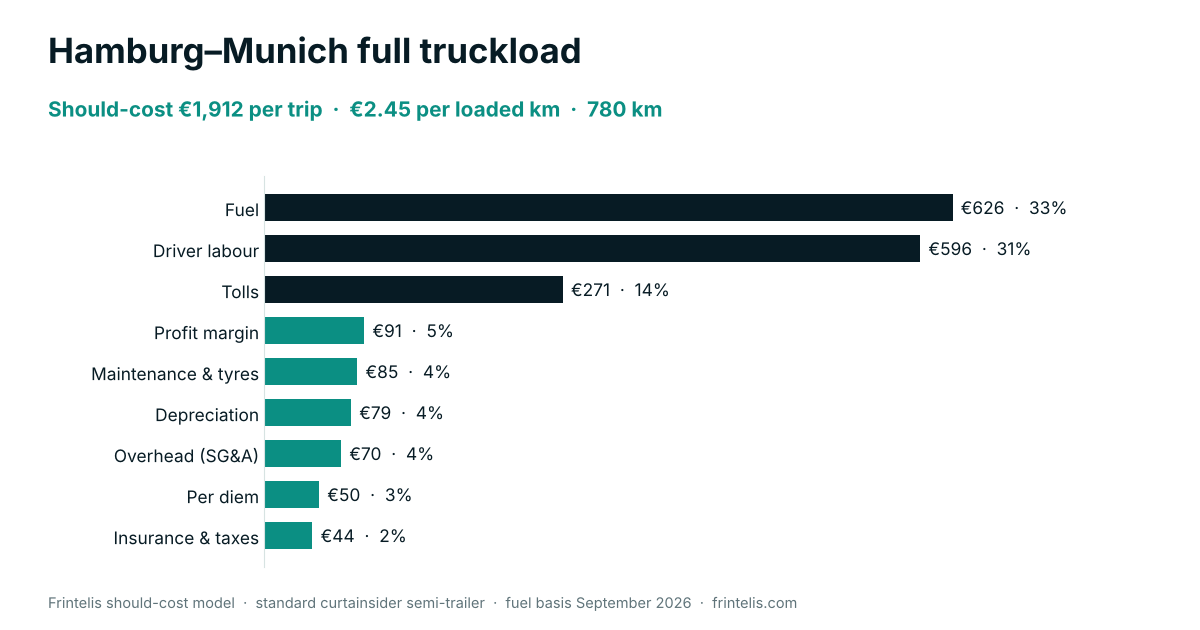
| Cost element | € / km | € / trip | Share |
|---|---|---|---|
| Fuel | 0.802 | 626 | 32.7% |
| Driver labour — German driver | 0.764 | 596 | 31.2% |
| Tolls | 0.348 | 271 | 14.2% |
| Profit margin | 0.117 | 91 | 4.8% |
| Maintenance & tyres | 0.109 | 85 | 4.4% |
| Depreciation | 0.101 | 79 | 4.1% |
| Overhead (SG&A) | 0.090 | 70 | 3.7% |
| Per diem | 0.064 | 50 | 2.6% |
| Insurance & taxes | 0.056 | 44 | 2.3% |
| Total should-cost | 2.451 | 1,912 | 100% |
Reading the stack
- Fuel €626 — about 257 litres at €2.44/l. A 10% fuel move is worth €68 a trip, which argues for indexing the fuel component instead of re-tendering the lane.
- Labour €596 plus €50 per diem — a German driver across 2.0 driver days, 12 h 34 of driving and breaks plus four hours of handling.
- Tolls €271 — Germany alone accounts for €271. Tolls are published tariffs, so they can be treated as verifiable pass-through.
- Asset and overhead €278 — depreciation, maintenance, tyres, insurance, taxes and SG&A on a three-year-old combination.
- Margin €91 (4.8%) — the carrier profit assumption in the model. Two more points of margin are worth €36 a trip.
How much are the tolls between Hamburg and Munich?
| Country | km | Toll | € / km |
|---|---|---|---|
| Germany | 780 | €271 | 0.348 |
| Total | 780 | €271 | 0.348 |
What could move the number?
| Change | Effect / trip | vs base | Commercial question |
|---|---|---|---|
| Diesel +10% | +€68 | +3.6% | Which index, baseline and adjustment frequency apply? |
| Polish driver base instead of German | −€316 | -16.5% | Which establishment country does the offer assume? |
| Empty running +100 km | +€134 | +7.0% | Can the carrier evidence its backhaul on this lane? |
| Three chargeable waiting hours | +€170 | +8.9% | When does detention start, and at what hourly rate? |
| Margin +2 points | +€36 | +1.9% | Is margin taken on cost or on revenue? |
The lane is costed on a German driver base. The same work on a Polish driver base models at €1,596, which is €316 lower. Cabotage rules limit how far a non-resident carrier can run domestic work, so ask which establishment the offer assumes.
Three chargeable hours of waiting cost €170, about €57 an hour. If a quote carries a dwell contingency, it belongs in a detention clause with a free period and an hourly rate, where it is paid only when the delay happens.
What does the lane cost per pallet?
| Unit | At should-cost |
|---|---|
| Cost per trip | €1,912 |
| Cost per loaded km | €2.451 |
| Cost per pallet (33 pallets) | €57.94 |
| Cost per m³ (90 m³) | €21.25 |
| Cost per kg (24 t payload) | €0.080 |
How to read a quote against it
Fuel, labour and tolls are €1,493 of the €1,912: road cost that any compliant carrier on this lane has to absorb. The commercial conversation concerns the remaining €419 of asset, overhead and margin.
- Up to about €2,008 (+5%) — within the tolerance of the model's inputs. The quote is explained by cost.
- €2,008 to €2,199 (+5% to +15%) — ask which element differs: labour base, empty running, waiting allowance or margin.
- Above €2,199 (+15%) — a premium of more than €287 a load that the cost base does not explain and the carrier should itemise.
- Well below €1,816 — check what the offer assumes about backhaul and labour base before treating it as a saving. A rate under cost rarely survives the contract term.
Four questions to take into the carrier meeting
- Which labour-cost base and establishment country does the offer assume?
- How much empty running is priced in, and what network evidence supports it?
- Which items are fixed, which indexed, and which treated as verifiable pass-through?
- What loading and waiting time is included in the linehaul, and when does detention begin?
A should-cost result is a decision anchor, not a price ceiling. Market imbalance, capacity, service conditions and carrier network economics can all justify a rate above the model. The purpose is to know how much of a quote the carrier is being asked to explain.
Method and scope
Figures are produced by the Frintelis should-cost engine from the lane inputs in the assumptions table and a dated European reference set covering fuel, labour, toll, asset, maintenance and overhead cost. The model is deterministic: identical inputs return an identical result. Fuel prices are pump prices from the EU Weekly Oil Bulletin for the week of 28 September 2026; tolls are net of VAT.
This is a cost model, not a market price index. It does not observe transacted rates and it does not forecast them. In the application the same lane can be re-run with your own distance, equipment, waiting time and labour base.
Other lanes
- Rotterdam–Munich — €2,028 per trip, €2.41 per loaded km
- Budapest–Munich — €1,440 per trip, €2.12 per loaded km
- Barcelona–Lyon — €1,395 per trip, €2.18 per loaded km
- Timișoara–Munich — €1,980 per trip, €1.99 per loaded km
- Paris–Madrid — €2,485 per trip, €1.96 per loaded km
- All lane briefs
Need this for your own lanes?
1 — Frintelis, the platform
Model your own lanes, run sensitivity testing and export the breakdown for your tender file. Currently in an invitation-only pilot.
2 — Advisory: tender and cost-model support
Should-cost positions for your lane set before quotes come in, and a structured read of the field once they do. Independent: not a 4PL, not a broker, no carrier commissions.